There are periods in markets when the narrative and the numbers move in sync—and then there are moments when they quietly diverge. India’s technology sector is beginning to look like the latter. Companies continue to deliver strong revenue growth, with many approaching meaningful profitability milestones, yet stock prices and investor sentiment have lagged behind.
This dynamic is especially relevant for investors looking at India’s digital economy through vehicles like the India Internet Index (INQQ), which is designed to capture the growth of the country’s internet and technology sector. Despite the strength of the underlying businesses, returns have not reflected that progress in the way many expected—raising an important question: is the market missing something? Many investors have found themselves asking what to make of investing in India tech right now?
That tension is worth paying attention to. Because when fundamentals strengthen while valuations compress, the gap that forms is not necessarily a warning sign—it is often where opportunity begins.
A Structural Growth Story That Remains Intact
At a foundational level, India’s economic trajectory continues to stand out. The country remains one of the fastest-growing major economies in the world, supported by a powerful combination of demographic expansion and rising consumption. A rapidly growing middle class is reshaping demand across sectors, while a mobile-first population is accelerating the adoption of digital services in everyday life.
What makes this growth especially compelling is the infrastructure beneath it. Over the past decade, India has built a robust digital backbone spanning payments, identity, and data-sharing systems. These public rails have dramatically lowered the barriers to entry for internet businesses, enabling companies to scale quickly and efficiently.
In many ways, India is no longer just an emerging participant in the digital economy—it is becoming a blueprint for how digital ecosystems can be built at scale. India isn’t just growing; it’s becoming one of the most important digital economies in the world.
Strong Business Performance, Muted Market Response
Despite these favorable conditions, public market performance across India’s technology and internet companies has been notably subdued. This is where the disconnect becomes most apparent.
Many of these businesses continue to grow revenues at rates between 20% and 40%, levels that would typically command premium valuations globally. At the same time, there has been a meaningful shift in how these companies operate. Management teams are increasingly prioritizing efficiency, refining unit economics, and focusing on sustainable profitability after years of aggressive expansion.
And yet, stock prices have struggled to reflect that progress.
Part of this can be explained by the broader macro environment. Higher interest rates, a more risk-averse global investment climate, and a rotation away from growth assets have all played a role. There has also been a natural cooling of sentiment following periods of heightened optimism.
But the result is a clear and compelling disconnect: strong growth and improving profitability, yet prices haven’t followed.
The INQQ Story: Investing Through the Disconnect
This dynamic is not new—it is, in fact, embedded in the experience of investing in India’s internet sector over the past several years.
Four years ago, we launched INQQ based on a simple but high-conviction thesis: India was under-owned and misunderstood in U.S. portfolios, with average exposure still below 1%. At the same time, the country was on track to become one of the largest economies in the world, with a strengthening geopolitical position and a rapidly scaling digital ecosystem. The internet sector, in particular, stood out as one of the fastest-growing areas of the economy and a key driver of future GDP growth.
Since then, the journey has not been linear.
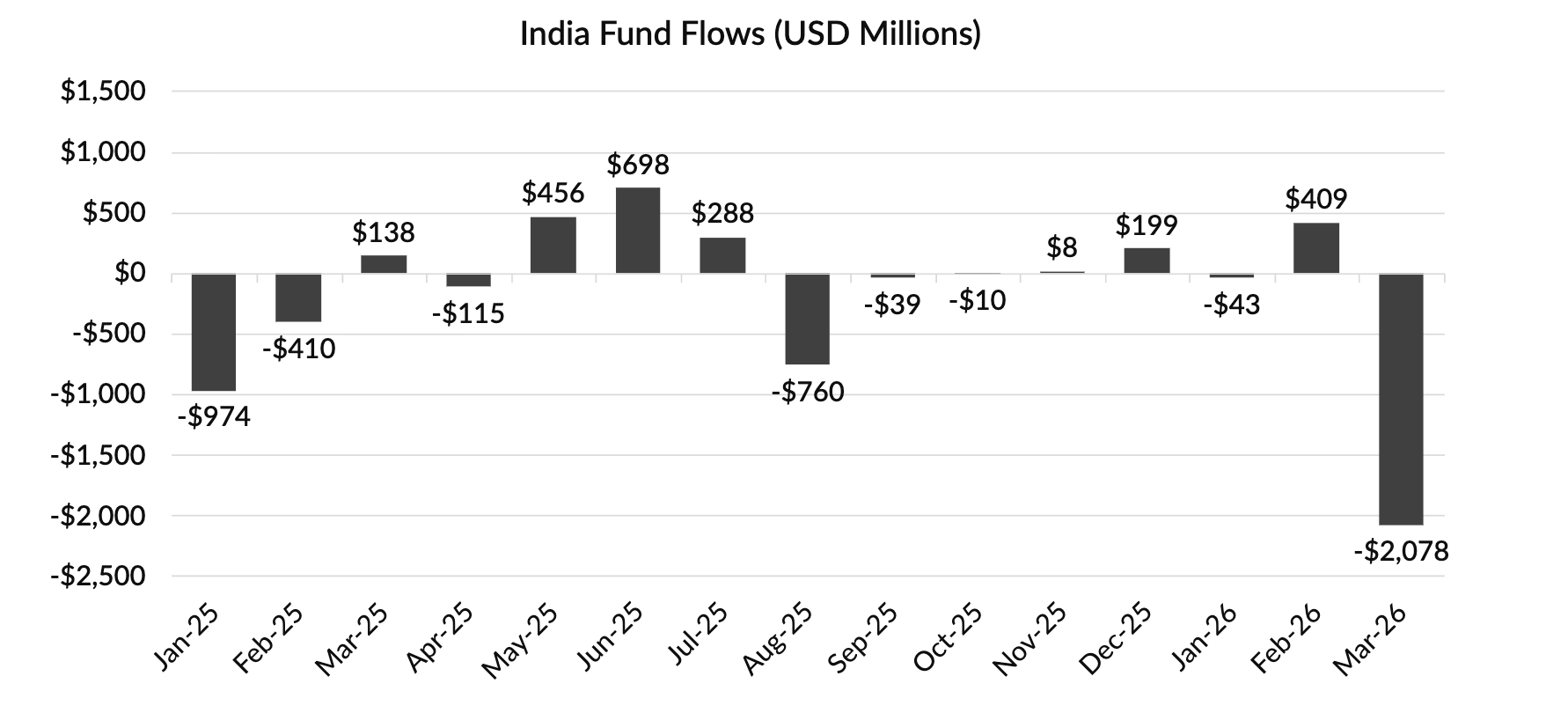
The index underlying INQQ is down roughly 25% over that period. Valuations have compressed to near historic lows, with a PEG ratio around 0.9. Foreign sentiment has deteriorated meaningfully, culminating in a peak period of outflows earlier this year, when India-focused ETFs saw over $2 billion exit the space in a single month. Today, INQQ sits at approximately $50 million in assets under management.
On the surface, those datapoints might suggest a thesis under pressure.
But in reality, they reflect something else entirely: a growing disconnect between fundamentals and sentiment.
Source: Bloomberg
Because beneath the surface, the core drivers of the original thesis remain intact—if not stronger. Growth continues. Business models are maturing. Profitability is improving. And yet, investor positioning has reached one of its most pessimistic extremes.
As EMQQ Global advisor and acclaimed investor Burton G. Malkiel famously wrote, “the most profitable investments you will ever make are precisely at the times when pessimism is the most rampant.”
That idea feels particularly relevant today.
AI and the Next Phase of Growth
At the same time, a new layer of opportunity is beginning to take shape. Artificial intelligence is rapidly being integrated across India’s leading digital platforms, enhancing both growth and efficiency.
Across sectors like commerce, fintech, and online services, AI is improving personalization, optimizing logistics, strengthening fraud detection, and transforming customer engagement. These capabilities are not just incremental—they are reshaping how companies operate and scale.
What makes India unique in this context is the combination of AI with a still-expanding digital user base. Hundreds of millions of users are coming online, generating vast amounts of data that can be leveraged to improve AI systems in real time. This creates a powerful compounding effect, where adoption, intelligence, and monetization reinforce one another.
A Broader Lens: The EMQQ Global Portfolios
For investors, this raises an important question around positioning.
INQQ offers targeted exposure to India’s internet and technology sector—arguably one of the most dynamic and fastest-growing segments of the economy. It is a focused expression of the view that India’s digital platforms will continue to scale and play an increasingly central role in global growth.
At the same time, EMQQ and FMQQ provide a broader lens on the same structural theme across emerging markets. While INQQ concentrates on India, EMQQ captures the wider opportunity set of internet and e-commerce companies across the developing world, offering diversified exposure to similar digital transformation trends playing out globally. FMQQ captures that same theme ex-China.
Together, they reflect a shared belief: that the next wave of global growth will be driven not just by developed market incumbents, but by digital platforms emerging from some of the world’s fastest-growing economies.
A Rare Misalignment Between Fundamentals and Sentiment
When viewed together, the current setup in India tech is unusually compelling. The underlying drivers of growth remain firmly in place. Profitability is improving as companies mature. And yet, valuations remain compressed, reflecting a far more cautious sentiment than the fundamentals might justify.
This is a rare alignment: growth is intact, profitability is improving, and valuations are compressed.
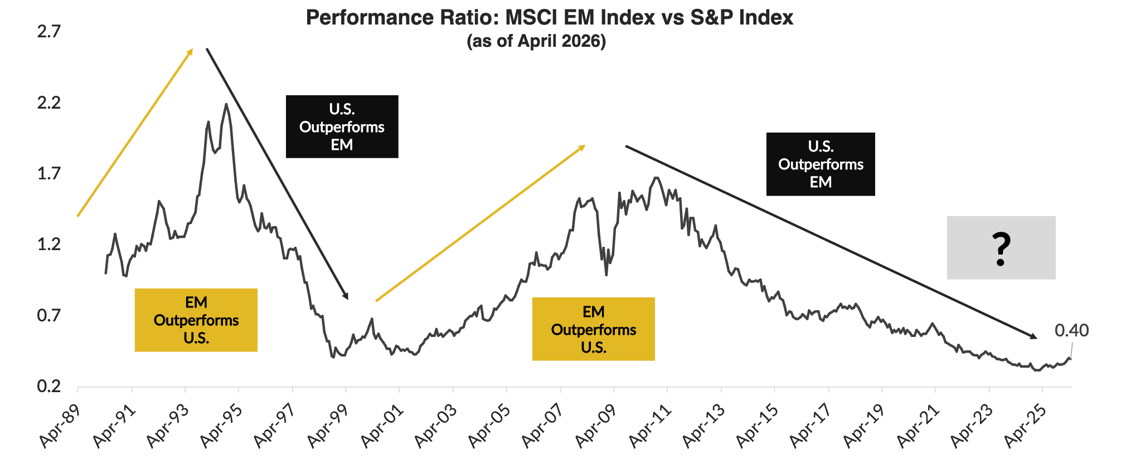
Markets do not tend to leave these gaps open forever.
Source: Bloomberg
What This Moment Means for Investors
India today sits at the intersection of structural economic growth, a rapidly scaling digital ecosystem, and an emerging wave of AI-driven innovation. It is not simply participating in the global technology landscape—it is becoming increasingly central to it.
The key question for investors is not whether India’s digital economy will continue to expand, but how much of that expansion is already reflected in valuations.
Right now, the answer appears to be: not enough.
The performance of INQQ over the past four years underscores an important reality: investing in transformative growth stories is rarely a straight line. Periods of optimism are often followed by phases of doubt. But it is often within those periods of doubt—when sentiment is weakest—that the most compelling opportunities emerge.
For investors willing to take a longer-term view, today’s environment may represent exactly that kind of moment.
Because when pessimism peaks but fundamentals persist, the opportunity is not just intact—it may be even stronger than before.