
EMQQ Global Performance Overview
-
The EMQQ Index jumped 10.2% in July. YTD, the index is down 14.8%.
-
The FMQQ Index gained 6.1% for the month. YTD, it has declined 9.5%.
-
The INQQ Index increased 3.8% in July. YTD, it is down 9.2%.
The leading positive contributors to performance for the EMQQ Index in July both hailed from China: Alibaba Group and Meituan. The former continues to build out its AI ecosystem, releasing models that are on par with US counterparts on performance, while also broadening its investment portfolio across the AI value chain in China.
The largest detractor for the month was South Korea’s leading e-commerce company, Coupang, falling 5.9% due to some temporarily discontinued operations at one of the company’s warehouses in Korea.
Sources: Bloomberg, Company financials
Emerging Markets Tech News to Know
At a Glance:
-
Alibaba AI Investments Begin to Reap Gains
- NVIDIA Makes Strategic Investment in South Korea’s Naver
- Eternal’s Revenue Surges on the Back of Quick Commerce in India
- Alibaba Adds to China’s AI Breakthroughs
- Nubank CEO Joins OpenAI Board
-
Chart of the Month
Alibaba AI Investments Begin to Reap Gains
Alibaba is building a diversified portfolio of investments across artificial intelligence and semiconductors. The company has increasingly focused on strategic minority stakes and partnerships that expand its exposure across the AI value chain. Its early investment in memory-chip leader CXMT has generated substantial paper gains, while backing model developers such as Zhipu AI, Moonshot AI, MiniMax, Baichuan AI and 01.AI has strengthened its position in the rapidly growing AI market. Alibaba invested roughly $800 million in Moonshot for an approximately 36% stake and continued participating in later funding rounds. Together, these investments complement Alibaba’s Qwen models, cloud platform and semiconductor capabilities, positioning the company as a broad-based participant in AI infrastructure, model development and commercialization.
NVIDIA Makes Strategic Investment in South Korea’s Naver
NVIDIA plans to invest $1 billion in Naver, deepening a partnership aimed at expanding the South Korean company’s artificial-intelligence infrastructure and global cloud capabilities. Naver is one of South Korea’s leading internet companies, offering search, cloud, e-commerce, fintech, and AI services. Together with up to $9 billion of financing from Brookfield, the investment will support expansion of Naver’s GAK data center in Sejong to 200 megawatts by 2028. The facility will use Nvidia’s next-generation Vera Rubin and Blackwell platforms, giving Naver greater computing capacity to train models, deliver AI services and serve enterprise customers. The partnership also strengthens Naver’s opportunity to address growing sovereign-AI demand across Asia, Europe and the Middle East, where governments increasingly seek locally controlled data and infrastructure. Naver is a constituent of the EMQQ Emerging Markets Internet Index.
Eternal’s Revenue Surges on the Back of Quick Commerce in India
India’s Eternal strengthened its position in quick commerce (ultra-fast 10-minute e-commerce deliveries in India) during the second quarter, with Blinkit’s net order value rising 86% year over year and its store network expanding by 200 locations to 2,443. The business also reached operating-level profitability, an important milestone suggesting rapid growth is increasingly being matched by improving unit economics. Management now expects Blinkit’s long-term adjusted EBITDA margin to land toward the high end of its prior 5%–6% target. At the same time, Eternal’s established Zomato food-delivery platform remains a profitable engine that can help fund Blinkit’s expansion. Together, the two businesses give Eternal a compelling model: a mature digital-delivery franchise supporting one of India’s fastest-growing consumer-internet opportunities, with scale, customer retention, and profitability all moving in the right direction.
Alibaba Adds to China’s AI Breakthroughs
Alibaba has introduced Qwen3.8-Max, its most advanced artificial intelligence model to date, strengthening the company’s position among global AI leaders. Built with 2.4 trillion parameters, the model reportedly outperformed Moonshot AI’s recently launched Kimi K3 on several benchmarks and delivered results comparable to Anthropic’s Fable 5. Qwen3.8-Max is designed for autonomous coding and long-duration tasks, completing a software-engineering project independently over 16 days during internal testing. Its mixture-of-experts architecture activates only portions of the model when needed, helping reduce computing costs and latency. Alibaba plans to release the model’s weights for public download, allowing developers to customize and deploy it. The launch highlights Qwen’s rapid progress and Alibaba’s growing role in advancing powerful, accessible AI models across the global
Nubank CEO Joins OpenAI Board
Nubank founder and CEO David Vélez joined the boards of both the OpenAI Foundation and OpenAI Group in July, a notable endorsement of his leadership beyond Latin American internet banking. OpenAI highlighted Vélez’s experience building Nubank into the region’s largest digital bank while expanding financial access through technology. His appointment reinforces the view that Nubank is not simply a fintech company, but a scaled technology platform with deep expertise in artificial intelligence, data, regulation, and consumer engagement. It also places Nubank’s leadership closer to the center of global AI development, potentially strengthening the company’s strategic understanding of how advanced models can transform underwriting, customer service, personalization, and financial advice.
Chart of the Month
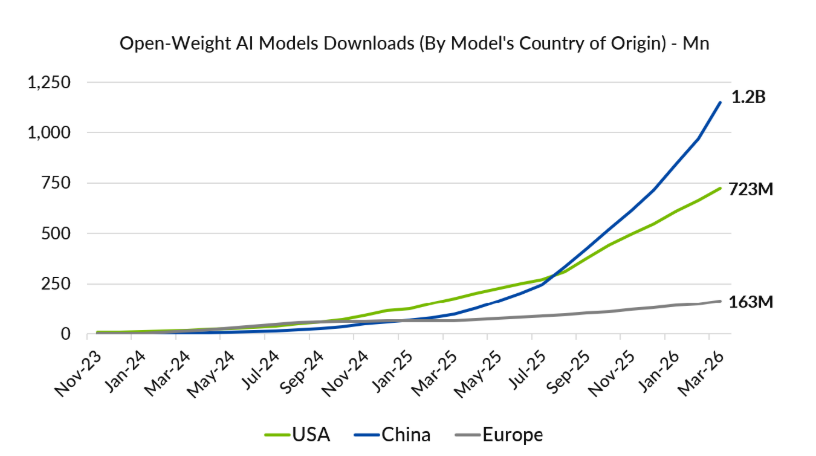
China’s open-weight AI models are rapidly gaining global adoption and popularity, expanding demand for the computing infrastructure needed to run them. This trend can benefit cloud operators such as Alibaba Cloud, which hosts models—including its Qwen family—and provides developers with computing power, deployment tools, and services. Greater model usage can translate into rising cloud workloads and stronger AI-driven revenue and earnings growth for Chinese cloud operators including Alibaba, Tencent and Baidu. Alibaba alone says it expects its cloud revenue to hit $100 billion over the next five years, up from $22 billion in its last fiscal year.
Source: Yahoo Finance