
EMQQ Global Performance Overview
- The EMQQ Index fell 2.1% in January.
- The FMQQ Index declined 3.9% for the month.
- The INQQ Index pulled back 8.1% in the first month.
The leading positive contributors to performance for the EMQQ Index in January came from Alibaba and Latam’s Mercadolibre. The former continues to aggressively implement AI across its vast tech ecosystem, from AI chips to consumer apps. Meanwhile, MercadoLibre got a boost on news that it’s using AI to help accelerate its fintech business. More on both below.
The two largest detractors for the month were India’s Reliance and China’s PDD Holdings. Reliance cooled off in the first month of the year after a strong 2025, but the company is widely expected to list its internet and tech arm, Jio Platforms, in the next few months. More on that below. While Pinduoduo also pulled back for the month, the company’s growth is expected to accelerate in 2026 as it continues its global expansion behind its popular app “Temu.”
Sources: Bloomberg, Company financials
Emerging Markets Tech News to Know
At a Glance:
-
India and US Reach Trade Deal to Slash Tariffs
- Alibaba Deeply Integrates AI Across Business Units
- MercadoLibre Pushes AI Ambitions in Fintech Unit
- Alibaba Eyes IPO of AI Chip Unit
- Two Pivotal Indian Internet IPOs on the Horizon
- Baidu’s AI App hits 200M Active Users
- Paytm Launches India’s First AI Soundbox
-
Chart of the Month
India and US Reach Trade Deal to Slash Tariffs
President Trump announced that the US and India have reached a trade agreement under which both countries will immediately begin lowering tariffs on each other’s goods after an escalation that began last year. Washington plans to reduce its tariffs on Indian products, paving the way for expanded market access and stronger commercial ties. Indian markets rose on the news, reflecting optimism about enhanced economic collaboration and future growth. The agreement reinforces India’s role as a key global trading partner and sets the stage for deeper economic cooperation between the world’s two largest democracies. The deal also puts a key overhang on Indian equities behind us.
Alibaba Deeply Integrates AI Across Business Units
Alibaba is transforming its AI assistant, Qwen, from a standalone chatbot into a gateway that integrates deeply into its sprawling consumer internet businesses. The company has connected the app to core platforms like Taobao (e-commerce), Alipay (payments), and Fliggy (online travel), enabling users to do things such as shop, pay, or book travel without leaving the AI interface. This ecosystem link boosts real-world utility and helps drive adoption, with Qwen surpassing 100 million monthly active users within two months of launch. By embedding AI directly into everyday tasks across its digital commerce and services, Alibaba aims to differentiate Qwen from competitors and strengthen its position in the consumer AI market.
MercadoLibre Pushes AI Ambitions in Fintech Unit
MercadoLibre is steadily expanding Mercado Pago from a payments engine into a broader digital banking platform across Latin America. By deploying AI-driven personalization, underwriting, and financial guidance, the company aims to deepen engagement and extend relationships well beyond e-commerce. The strategy fits MercadoLibre’s long-running ecosystem playbook, where commerce, payments, credit, and logistics reinforce one another. A larger fintech footprint can unlock new fee streams, richer data insights, and tighter links between shopping and financial activity for tens of millions of users. In a region that remains structurally underbanked, offering more financial services inside a familiar app supports adoption and retention. While execution and risk management matter, the digital banking push strengthens MercadoLibre’s competitive moat and long-term monetization potential.
Alibaba Eyes IPO of AI Chip Unit
Alibaba is laying the groundwork to unlock long-term value by preparing a potential listing of its chipmaking unit, T-Head. The move reflects Alibaba’s broader strategy to deepen its role across the AI value chain, from foundational hardware to large-scale cloud and consumer applications. Backed by years of sustained investment, T-Head has emerged as a credible domestic semiconductor contender, winning commercial deployments of its AI accelerators at major data centers and expanding partnerships with leading telecom operators. This momentum complements Alibaba’s aggressive AI push, including major infrastructure spending and rapid progress in consumer AI via its Qwen platform.
Two Pivotal Indian Internet IPOs on the Horizon
PhonePe, India’s largest digital payments app, and Reliance Jio, India’s largest internet player, are both slated to IPO in the next few months. The expected public listings mark a pivotal moment for India’s internet economy. PhonePe’s IPO would highlight the scale and maturity of India’s digital-payments ecosystem, built on UPI and supported by hundreds of millions of active users across commerce, finance, and everyday transactions. Reliance Jio’s listing, meanwhile, would underscore how affordable data, nationwide 4G/5G coverage, and a vertically integrated digital platform have transformed internet access and consumption in India. Together, these IPOs signal that India’s leading internet platforms are reaching global scale, profitability, and institutional readiness. More importantly, they reflect a broader runway ahead—driven by rising smartphone penetration, rapid digital adoption in Tier-2 and Tier-3 cities, and expanding use cases in fintech, e-commerce, media, and AI-enabled services.
Baidu’s AI App hits 200M Active Users
Baidu, the “Google of China,” continues to aggressively build out its AI ecosystem. The company’s AI assistant, powered by its Ernie large-language model, has reached a major milestone of 200 million monthly active users, according to The Wall Street Journal. Deeply integrated into Baidu’s flagship search app and desktop platforms, this AI interface lets users perform everyday tasks—like booking flights, ordering food, generating images or videos, and writing summaries—without leaving the app ecosystem. The rapid adoption underscores China’s growing momentum in generative AI and highlights Baidu’s ability to scale its AI offerings across its broad user base.
Paytm Launches India’s First AI Soundbox
Paytm has unveiled its AI-powered Soundbox, India’s first intelligent business device for merchants, marking a major leap in how small and medium enterprises interact with digital payments and business data. The upgraded Soundbox goes beyond simple payment alerts, incorporating a built-in AI assistant that speaks with merchants in 11 local languages, offers real-time insights on transactions and performance, and provides business summaries on demand. This transforms it into a true AI business assistant, helping shopkeepers manage payments, track trends, and make smarter decisions without needing complex apps. By embedding advanced AI at the grassroots level, the launch strengthens Paytm’s leadership in India’s fintech landscape while driving deeper merchant engagement and financial inclusion.
Chart of the Month
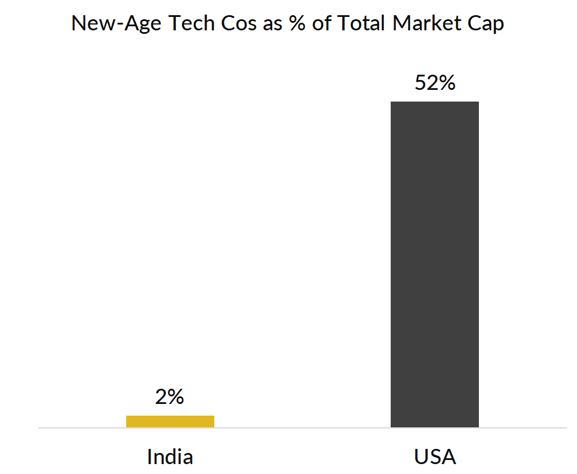
While India’s public internet sector has grown dramatically in depth over the last few years, it remains at a very nascent stage. As the technology and internet sectors continue to gain global market share, internet companies' share of India’s total market capitalization remains below 3%.
Source: Money Control